Table of Contents
When choosing windows for a new home or renovation in Punjab, you'll face this decision in almost every room: sliding or casement? Both are available in aluminium and uPVC, both come with modern hardware and DGU options — but they behave very differently in daily use. This guide helps you make the right call for each room.
What's the Difference?
Sliding windows move horizontally along a track. One or both panels slide to the side to open. They require no clearance space outside the window plane — the panel moves within the frame's footprint.
Casement windows are hinged on one side and swing outward (or inward, in the tilt-turn variant) like a door. They open to roughly 90°, providing a full, unobstructed opening. They require clearance space in the direction they open.
1. Ventilation
Casement windows win clearly on ventilation. When open, a casement provides the full frame area as an opening — every square centimetre of the window becomes a pathway for air. This is why casement windows are traditionally favoured for kitchens, bathrooms, and utility rooms where maximum airflow matters.
Sliding windows, by contrast, open to a maximum of 50% of the frame area in a standard 2-panel design (one panel slides behind the other). In a 4-panel design, you can open two panels, but still only 50% of the total area at most. For Punjab's hot summers when cross-ventilation is critical, this is a meaningful difference.
Ventilation winner: Casement. For rooms where airflow matters most — kitchens, utility rooms, ground floor rooms in non-AC homes — casement is the better choice.
2. Space Efficiency
Sliding windows win decisively on space efficiency. Because they move horizontally within the frame, they don't need any clearance outside, inside, or below the window. This makes them ideal for:
- Rooms where furniture sits close to the window
- Locations where the window faces a walkway, verandah, or neighbour's compound
- Narrow window reveals where a casement's swing arc would be obstructed
- Large openings where a casement panel would be too heavy and unwieldy
In Punjab's typical apartment and kothi layouts — where windows often face enclosed light wells or internal courtyards — sliding windows are often the only practical option.
3. Security
Modern casement windows with multi-point locking systems are among the most secure window types available. The locking mechanism engages at multiple points around the frame perimeter — not just at a central handle. A properly locked casement is very difficult to force open from outside.
Sliding windows are inherently slightly more vulnerable because of the horizontal track — an experienced burglar knows that older sliding windows could be lifted off their track. Modern sliding windows address this with anti-lift channels and track pins, but the fundamental geometry still makes casement a marginal winner on security.
For ground-floor windows in Punjab — where security concerns are heightened — casement windows with multi-point locking and toughened glass offer the highest protection.
4. Aesthetics & Design
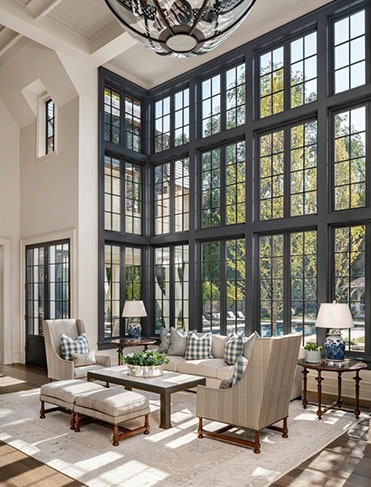
Sliding windows have a clean, horizontal aesthetic that suits contemporary architecture. The wide glass expanse with minimal visible frame works well in modern homes, apartments, and commercial spaces. Large aluminium sliding windows are a signature feature of the premium villa and farmhouse projects increasingly popular across Punjab's new developments.
Casement windows have a more traditional, architectural look. The visible hinge and opening mechanism gives character to the facade. In classic kothi-style homes in Amritsar, Patiala, or Jalandhar's older neighbourhoods, casement windows sit naturally within the design language. Casement windows are also used in premium modern homes when the design calls for a more articulated facade.

5. Maintenance
Both window types are low maintenance in aluminium and uPVC. However, there are small differences:
- Sliding windows: The horizontal track collects dust over time — especially in Punjab's pre-monsoon dust season (March–May). Tracks should be vacuumed and cleaned every 3–4 months. Rollers need occasional lubrication (every 1–2 years).
- Casement windows: The hinge mechanism needs occasional lubrication. The window seal around the perimeter should be checked annually. Because they swing outward, the outer frame gets more exposure to rain — ensure the drainage holes in the frame are not blocked.
Neither requires painting, sealing, or rust treatment when made from quality aluminium or uPVC.
6. Price Comparison
| Window Type | uPVC (₹/sq.ft) | Aluminium (₹/sq.ft) |
|---|---|---|
| Sliding Window (2-panel) | ₹380 – ₹480 | ₹450 – ₹620 |
| Casement Window (single) | ₹350 – ₹450 | ₹480 – ₹650 |
| Casement Window (double) | ₹400 – ₹520 | ₹520 – ₹700 |
| Tilt-and-Turn (premium casement) | ₹500 – ₹680 | ₹620 – ₹800 |
Pricing is broadly similar between sliding and casement at comparable sizes. Casement windows have more hardware complexity (hinges, multi-point lock mechanism), which adds slight cost — but sliding windows of large dimensions have heavier glass, which balances out. For practical budgeting purposes, assume similar pricing and let function and aesthetics drive the choice.
7. Which Window for Which Room?
| Room | Recommended Type | Reason |
|---|---|---|
| Bedroom (standard) | Sliding | Space efficient, easy operation, good light |
| Master Bedroom (premium) | Casement or Tilt-Turn | Better ventilation, premium look |
| Kitchen | Casement | Maximum ventilation for cooking fumes |
| Bathroom | Casement (small) | Full ventilation in small frame |
| Living Room (large wall) | Sliding | Wide glass expanse, clean look |
| Study / Home Office | Casement | Fresh air on demand, good concentration |
| Ground Floor (security) | Casement with multi-point lock | Better security, harder to force |
| Upper Floors (large opening) | Sliding | Large widths, no swing clearance needed |
Final Recommendation
For most Punjab homes, the answer is not one type throughout — it's a thoughtful mix. A typical 3BHK might have:
- Sliding windows for bedrooms and the living room feature wall
- Casement windows for kitchen and bathrooms
- A large aluminium sliding door for balcony access
Aspire Windows manufactures all window types — aluminium sliding windows, casement systems, tilt-turn, and more — at our Bathinda factory. Our team will visit your site, assess each opening, and recommend the right type for each room — at no charge. Book your free site visit today.